In desert region homes, water damage doesn’t always arrive as a slow, obvious seep. It often shows up as a sudden plumbing failure during “hard water” wear-and-tear or a storm-driven intrusion that hits fast then disappears just as quickly, leaving moisture trapped where you can’t see it. ASAP Restoration even notes techniques adapted for desert conditions and hard water challenges, which is a good clue: your flooring isn’t just fighting water, it’s fighting how water behaves in this climate.
The problem is that flooring is built in layers. Even when the surface dries, moisture can remain in grout lines, underlayment, tack strips, subfloors, and wall edges. And once moisture is trapped, microbial growth can begin quickly, EPA guidance emphasizes acting within 24–48 hours after clean-water damage to reduce mold risk.
If you’re dealing with wet floors right now, CALL 602-515-7918 NOW for 24/7 emergency response.
Why water damage hits flooring so hard
Flooring assemblies are designed for controlled indoor humidity not for liquid water intrusion. When water enters, three things happen:
Wicking and capillary action
Water migrates sideways and downward often farther than the visible wet spot.
Adhesive and fastener failure
Glues emulsify, nails loosen, tack strips rust, and thinset can lose bond.
Hidden moisture = hidden risk
Moisture trapped under floors can feed swelling, delamination, odor, and (in the right conditions) microbial growth often before you see a stain.
Industry best practice for restoration is built around documentation, moisture measurement, and controlled drying, exactly the kind of procedural approach described in the ANSI/IICRC S500 standard scope.
Tile flooring: “waterproof” on top, vulnerable underneath
Tile is water-resistant at the surface, but tile systems are not watertight. The real vulnerabilities are grout lines, perimeter gaps, penetrations (toilets, vanities), and transitions.
What water does to tile assemblies
- Grout and joints absorb water. Cementitious grout is porous; water can move through it to the setting bed.
- Trapped moisture under tile can cause hollow spots. As moisture cycles, tiles can lose bond and sound “drummy.”
- Efflorescence and staining: Minerals can migrate and leave white hazing or discoloration—especially common where hard water deposits are already part of daily life.
- Subfloor issues: On wood subfloors, swelling below can shift the tile plane, leading to cracking.
Save vs. replace: quick rule of thumb
Tile can sometimes be saved if water exposure is brief, clean, and drying is verified below the assembly. If water is contaminated (overflow/sewage) or moisture is trapped beneath the tile with no drying path, removal may be necessary to prevent ongoing issues.
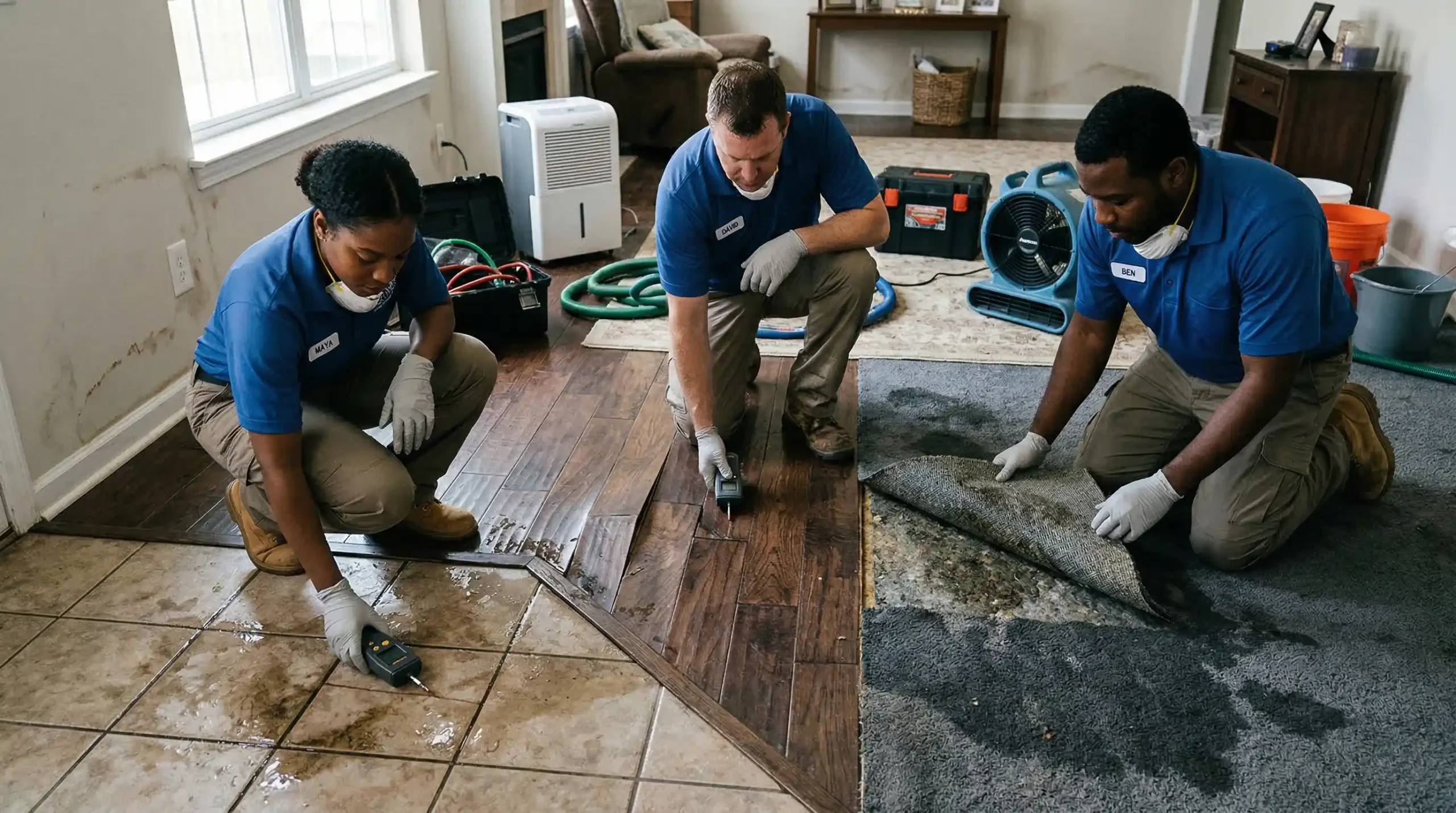
ASAP Restoration emphasizes moisture detection tools (including thermal imaging and moisture meters) to find what’s hidden critical for tile, where the surface can be misleading.
Wood flooring: warping is only the beginning
Wood is hygroscopic—it absorbs and releases moisture. When water hits, wood flooring can change shape within hours.
What water does to wood floors
- Cupping: Edges rise when the underside absorbs more moisture than the top.
- Crowning: The center rises when the top absorbs more moisture or after aggressive drying without balance.
- Buckling: Boards lift off the subfloor when swelling has nowhere to go.
- Finish failure: Cloudiness, peeling, or dark stains can develop, especially around seams.
Solid vs. engineered wood
- Solid hardwood tends to cup/crown dramatically.
- Engineered wood may resist cupping but can delaminate if water compromises the plywood layers and adhesives.
Climate factor: moisture swings matter
In desert climates, interiors often swing between dry ambient air and heavy localized moisture (like a leak soaking one room). That imbalance can worsen movement. ASAP Restoration specifically references workmanship adapted for desert conditions, which matters when drying and re-stabilizing wood assemblies.
Best move: Don’t assume a fan and time will fix it. The goal is controlled drying with verified moisture content otherwise boards may look better for a week and then gap, cup again, or develop odor.
Carpet: fast to feel wet, faster to hold onto what you don’t want
Carpet is often the first floor type to feel soaked—but it can also be the first to turn into a contamination and odor problem if mishandled.
What water does to carpet systems
- Padding acts like a sponge. Even if the carpet face dries, pad can remain wet and promote odor and microbial growth.
- Tack strip rust and subfloor wetting: Water travels to edges, wets baseboards, and can wick into walls.
- Delamination: Some carpet backings can separate when saturated and extracted repeatedly.
Clean water vs. contaminated water changes everything
If water came from a clean supply line and was addressed immediately, carpet may be salvageable with rapid extraction and drying. But if the source is an overflow, sewage backup, or drain problem, carpet and pad often require removal for health and sanitation reasons.
ASAP Restoration lists sewage backups and drain overflows among the types of losses they handle, and they include cleaning/sanitization as a core part of their restoration process.
Seasonal risk breakdown for desert-region properties
Desert communities commonly face a “dry-then-deluge” pattern: long stretches without rain followed by short, intense storm bursts that create rapid runoff and localized flooding. National Weather Service resources on monsoon-season flash flood risk describe how flash flooding increases during peak monsoon months—an important reminder that “no rain lately” doesn’t mean “no water risk.”
Dense urban corridors can also amplify water spread: more hardscape means more runoff and faster flow into low points and entryways—an effect documented broadly in USGS discussions of how development changes runoff and peak flows.
The first 24 hours: a flooring-saving checklist
Use this as a practical, non-technical triage list:
- Stop the source (shutoff valve / main) if safe.
- Avoid electrical hazards—don’t step into water near outlets or appliances.
- Move what you can, fast: rugs, small furniture, baskets, fabric items.
- Lift airflow barriers: open closet doors, remove soaked mats, pull items off the floor.
- Don’t trap moisture: avoid sealing wet rooms up tight without dehumidification.
- Document early: quick photos/video for insurance before demolition.
- Call for professional drying when water reached underlayment/subfloor (tile, wood, or carpet pad). Acting within the EPA’s 24–48 hour window is key for reducing mold risk after clean-water damage.
Insurance realities (and why documentation matters)
National insurance loss data shows water damage/freezing is a major, recurring claim category. Over the 2019–2023 period, ISO/Triple-I data shows water damage and freezing had a measurable claim frequency and an average claim severity of $15,400.
Coverage, however, depends on cause. Sudden events (like burst pipes) are often treated differently than gradual leaks. ASAP Restoration notes they work with insurance providers and help homeowners navigate the claims process and they emphasize documentation support.
Also, flood-related losses can involve separate considerations. NWS guidance commonly notes that flood losses aren’t covered under standard homeowners policies (flood coverage is typically separate), which matters if storm runoff enters your home.
When it’s time to call a certified restoration team
Call a pro (not just a handyman) when any of these are true:
- Water reached under tile, under wood, or into carpet pad.
- Floors feel “dry” but rooms smell musty or humidity stays high.
- You see tile hollowing, wood cupping, or carpet edge wicking.
- The source may be contaminated (overflow/sewage).
- The home is older and demolition could disturb suspect materials ASAP Restoration lists asbestos testing as a service, which may be relevant before removing older flooring components.
ASAP Restoration states they provide 24/7 emergency response and typically arrive within 60 minutes or less depending on location.
How ASAP Restoration approaches water-damaged floors
If your flooring is affected, you want a process that finds hidden moisture and verifies drying – not guesswork. ASAP Restoration outlines a step-by-step approach that includes:
- Emergency response & assessment using moisture detection tools
- Water extraction with high-powered equipment
- Drying & dehumidification with industrial air movers and dehumidifiers
- Cleaning & sanitization to address contaminants
- Restoration & repairs, including flooring restoration
- Final inspection & walkthrough
For hidden moisture beneath tile/wood assemblies, they also describe tools like thermal imaging cameras and moisture meters.
If you need urgent help, use their on-site language: Get Immediate Help! or Call Now: 602-515-7918.
FAQ
1) In desert-region homes, why do floors warp even when the leak “wasn’t that big”?
Because water spreads under flooring layers and dries unevenly – especially when indoor air is very dry but the subfloor is wet.
2) What are the first signs of water under tile in dense urban corridors?
Loose or darkening grout lines, a “hollow” sound when tapped, or dampness showing at transitions and baseboards.
3) Can wood floors be saved after a supply-line break in older slab-on-grade homes?
Sometimes if the water is clean, extraction is fast, and drying is controlled with moisture verification to avoid permanent buckling.
4) Why does carpet smell even after it “dries”?
Padding and tack-strip edges can stay wet long after the carpet face dries, holding odor and contaminants.
5) Should I run my HVAC after water damage?
Often yes for airflow, but only if it’s safe and not spreading contamination. A restoration team can advise based on the water category and the affected areas.
6) How quickly should I act after a mountain/valley runoff event pushes water indoors?
Immediately. Rapid response reduces secondary damage and helps stay within the common 24–48 hour mold-prevention window referenced by EPA guidance.
7) If water came from a drain overflow, can I keep my carpet?
That depends on contamination level and how far water traveled. Overflows can introduce bacteria that make removal more likely than with clean-water leaks.
8) Do I need asbestos testing before removing old flooring in legacy neighborhoods?
If the building is older and materials are unknown, testing is a safer step before demolition – especially when removing layers below finished flooring.
9) What documentation helps most for insurance when flooring is affected?
Early photos, a timeline of events, and drying documentation (moisture readings and equipment logs) are commonly useful.
10) How do I know if water reached the subfloor under engineered wood?
Look for swelling at seams, soft spots, or new squeaks – but the most reliable confirmation comes from moisture meters and targeted inspection.